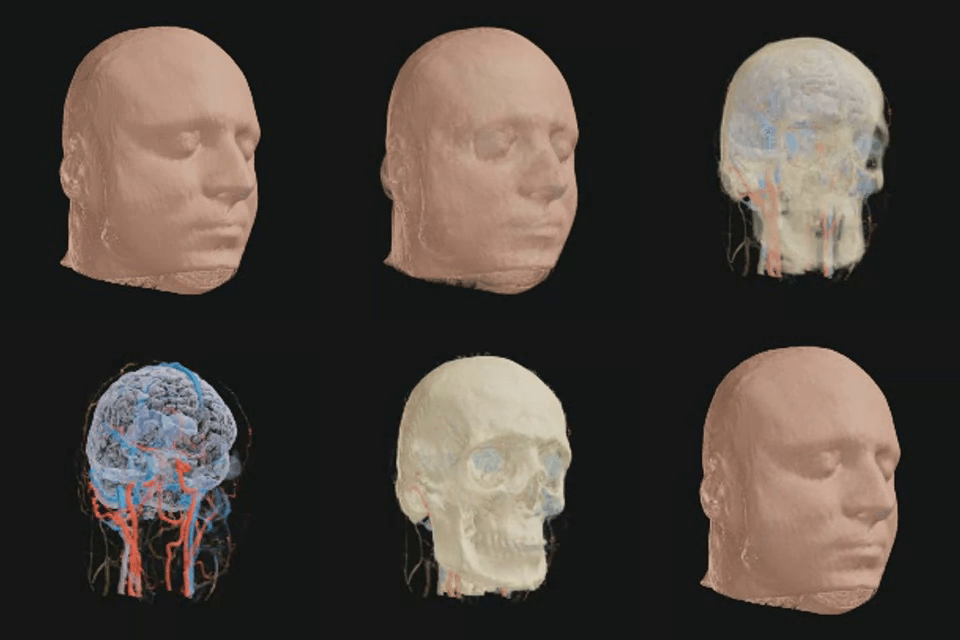
I’m turning my own MRI scans into an interactive 3D portrait of my brain and head, with help from AI and open-source imaging tools. You can rotate it, explore tissue layers and see how the scan slices become a browser-based model.
In 2023, I suddenly went blind. That was a fun day. Not many things cause that, none good.
It could have been worse.
Turns out, my body tried to eat my optic nerves, but I won. 20/20 vision baby, and slim to zero chance of recurrence. I have a rare autoimmune disorder, MOGAD, and some of the world’s best studying/fighting it are right here in Australia. I can't thank about 8 separate teams at the Royal Melbourne hospital enough.
Years later, one day I got bored. "Wait, I have a dvd with a scan of my brain, and I play with data". Could I interpolate something and build a custom model? 15,191 DICOM MRI images later...
The ultimate goal? Print a 3d model. That flashes for various reasons. Maybe when there's lightning. Or I get a quad-kill in Wardogs. Or when my wife's business gets another big, tasty order (that's happening a lot).
The thought of getting stimulus from my brain but smol, tickles me. There's something about it being visual stimulus, no less, that’s deeply, darkly ironic. (Fuck you, MOGAD. I win.)
once we have it, we can do some iiinterestin things. Animations. More interactivity. Maybe an educational visualisation of what MOGAD was up to. Etc.
About the project
Turning MRI scans into an interactive 3D portrait
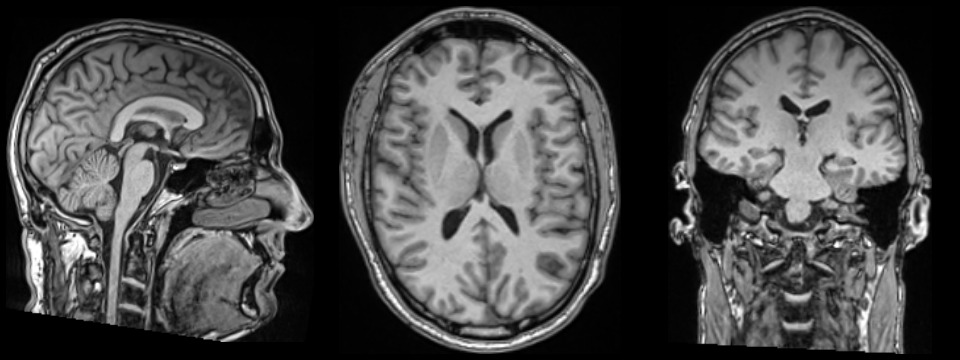
This portrait uses the head study, acquired on a Siemens MAGNETOM Sola 1.5 T MRI scanner at the Royal Melbourne hospital
A lot of those 15,191 images show the same anatomy at different times or from different angles. They aren’t all separate scans with new detail. For example, the angiography sequence contains 40 original volumes and 39 background-subtracted volumes following contrast through the vessels.
The images we used
- T1 MPRAGE, before and after contrast: two 208-slice volumes provide the main head and brain reference, with approximately 1 mm stored spacing.
- TWIST contrast angiography: the first nine subtracted phases provide the main vessel signal. All 39 subtracted phases were reviewed; their timing helps estimate arterial and venous groups.
- T2, FLAIR and susceptibility-weighted images: complementary views help cross-check brain, fluid and vessel boundaries.
- Targeted eye scans, including STIR and Dixon-water: supporting views help estimate the eye outlines. Eventually this will become a higher fidelity focus area.
How it comes together
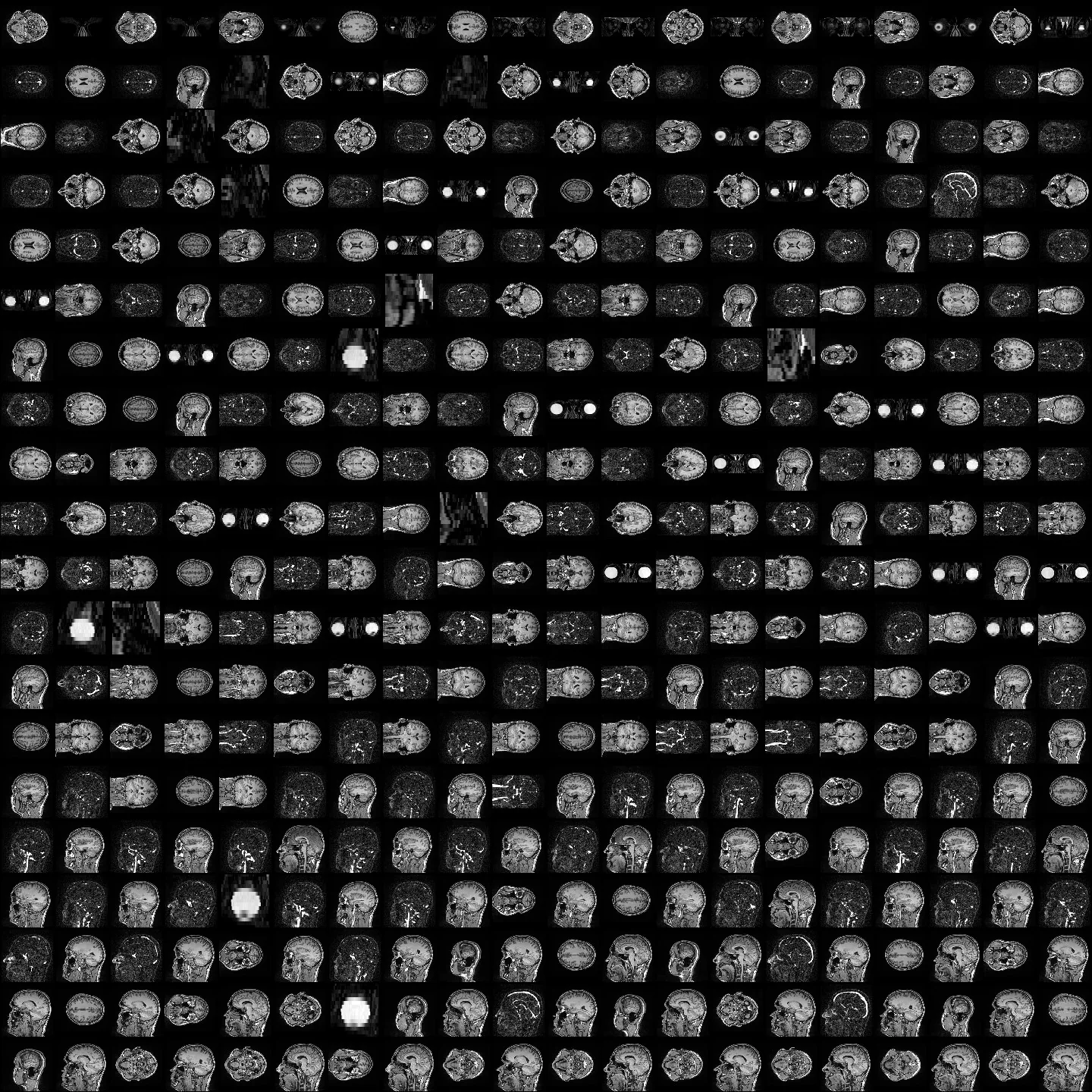
Slices were ordered by their recorded position and assembled into 3D volumes. Compatible head scans were re-aligned in the same physical space, and compared to estimate the tissue layers. Vessel signal is combined across the early contrast phases; different MRI contrasts support different structures, rather than being blindly added together.
The resulting volumes are compressed for the browser. The viewer samples through them to build the image you see, with separate colour and opacity controls. FreeSurfer helps estimate brain tissues; these boundaries and the vessel labels remain interpretations of the scans.
Where AI helped
This project combines AI-assisted development with MRI reconstruction and browser visualization. The scan slices provide the source data; imaging tools help align them and estimate tissue boundaries. The model is an interpretation of my scans, not a diagnostic model.
What’s being worked on
A more performant rendering method.
More refined detail from integrating more studies/scans.
Smoothing between slices.
AI-assisted experiments with gap filling.
A part / structure picker and index, highlighting system.
More performant rendering for mobile devices.
Finer vessel continuity and tissue boundaries.
Then the fun stuff.
Music-synced pulsing through veins/nerves/structures, affecting transparency, etc.
Material swapping. Turn the brain to glass. Veins to sand. Etc.
Whatever you come up with.
Credits + software used
Support
I like making creating, mentoring, creating tools, experiments, and things that make life a bit easier or give someone a laugh. You can find them on GitHub or in my portfolio.
If you got value from any of these, and you’d like to chuck us a coffee, or 100, feel free.Then hustle over to discord to claim your supporter role. If you’re feeling super generous, I prefer Aston Martin.
More things I made: browse the portfolio